
Symptom guide & repair
Sub-Zero not cooling in Los Gatos
Both sides warm, split temperatures, short-cycling, frost or a high-temp alarm — here is what it usually means and how we diagnose it in foothill kitchens.
- $89 service call, waived when you book the repair
- 365-day warranty on all labor
- Genuine OEM Sub-Zero parts
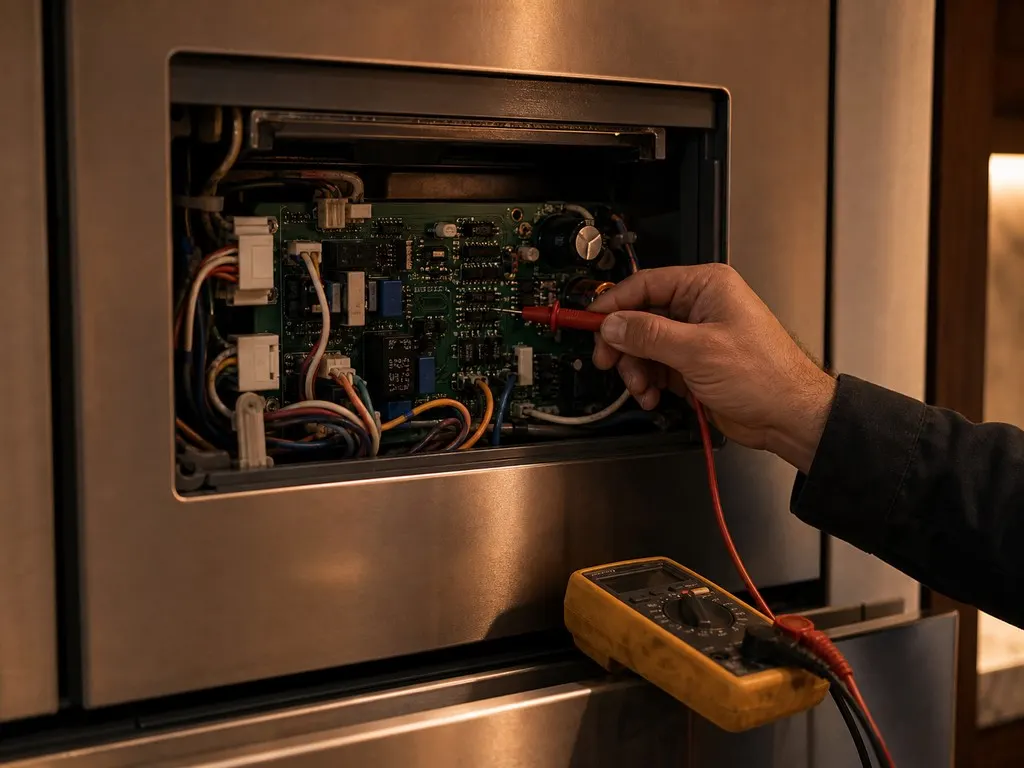
When a Sub-Zero stops cooling, the pattern matters more than the panic. Both sides warm usually points to the sealed system or a single compressor; one zone warm points to that zone’s evaporator, fan, or defrost circuit. We diagnose with factory-spec procedures, confirm the real fault before quoting, and fit factory-certified, genuine OEM Sub-Zero parts. The $89 service call is waived when you book the repair, and every fix carries our 365-day warranty on all labor across Los Gatos.
How the system works
Why dual refrigeration tells you where to look
Most Sub-Zero built-ins use two completely separate cooling circuits — one for the refrigerator, one for the freezer. That design is exactly why the symptom points to the cause.
In a dual-refrigeration model, the fresh-food and freezer compartments each have their own evaporator, and many units have their own sealed loop or a dedicated compressor stage. Air never crosses between zones the way it does in a cheap single-evaporator fridge, so when one compartment fails and the other stays perfect, that split is a diagnostic gift — it isolates the problem to one circuit before a probe ever comes out.
When both compartments drift warm together, the suspect list shifts to anything shared: the main control board, condenser airflow, the condenser fan, or a sealed-system fault that has starved the whole cabinet of refrigerant. We start by reading the unit’s own logic — service mode, sensor values, and fault history — instead of guessing, because a Sub-Zero will often tell you which evaporator or sensor is out of range if you know where to ask.
This is also where the Los Gatos angle matters. Built-ins in Almond Grove and Belgatos estates are framed into custom, panel-ready cabinetry with tight condenser clearances, and a clogged condenser on a foothill home that runs warm in summer behaves very differently from a failed compressor. Getting the distinction right is the difference between a routine cleaning and a sealed-system job — see our sealed system & compressor page for the deeper repairs, or built-in refrigerator repair for the broader picture.

Not-cooling symptoms and what each one usually means
Match what you are seeing to the most likely cause and the action we take. Cells describe tendencies, not guarantees — a proper diagnosis still confirms the fault.
| What you see | Most likely cause | What we check / do |
|---|---|---|
| Both sides warm, compressor quiet or constantly running | Sealed-system loss (refrigerant leak), failed compressor, or main control board not commanding cooling | Read service-mode data, verify compressor start & current draw, check condenser airflow, then pressure/leak diagnosis on the sealed system |
| Fresh-food warm, freezer still cold | Refrigerator evaporator fan failure, blocked air damper, fresh-food defrost issue, or that evaporator iced over | Confirm fan operation and damper position, inspect the FF evaporator for frost blockage, test the defrost heater and sensor |
| Freezer warm, refrigerator still cold | Freezer evaporator frost-up, defrost heater or bimetal failure, or a freezer-circuit sensor reading wrong | Check freezer evaporator and freezer defrost cycle, ohm the heater and thermistor, verify fan delivery |
| Compressor short-cycles (runs briefly, stops, repeats) | Overheating condenser, failing start components, low charge, or a control board fault | Clean/inspect condenser, test start relay and overload, measure run current, evaluate charge behavior under load |
| Heavy frost or ice on the back interior wall | Defrost system not clearing the evaporator (heater, sensor, or board), or a breached door gasket pulling in humid air | Run a controlled defrost test, verify heater and termination sensor, inspect gasket seal and door alignment |
| High-temp alarm or flashing temperature on the panel | Cabinet has risen past its setpoint — early sealed-system fault, airflow loss, a door left ajar, or sensor drift | Pull the fault log, confirm whether one or both zones tripped, then trace airflow, sensors, and the cooling circuit |
How it works
How we diagnose a Sub-Zero that is not cooling
This is the sequence an experienced specialist follows on site — and the first two steps are safe for you to try before you call.
- 1
Confirm power and the basics
Make sure the unit has power, the controls are not in showroom/Sabbath mode, and the temperature is actually set where you think it is. Check that the door is closing flush and nothing inside is blocking the air vents at the back of each compartment.
- 2
Read the temperatures, zone by zone
Note the fresh-food and freezer readings separately. A both-warm reading and a one-zone-warm reading send the diagnosis down completely different paths, so this single observation saves time before we ever open the unit.
- 3
Inspect condenser airflow
On built-ins the condenser sits behind the upper grille and pulls a surprising amount of dust — especially in hillside homes. A choked condenser makes a healthy compressor look like a failing one, so we always rule it out first.
- 4
Pull the control board fault history
In service mode the unit reports sensor values, evaporator temps, and stored faults. We compare what the board believes against what we measure, which exposes a lying sensor versus a genuine cooling failure.
- 5
Test the suspect circuit
Based on the pattern, we test the right components — evaporator fan, defrost heater and termination sensor, damper, or start components — with factory-grade tools rather than swapping parts on a hunch.
- 6
Verify the sealed system if needed
If the evidence points to refrigerant or the compressor, we evaluate the sealed system properly, then quote the real repair and fit factory-certified, genuine OEM Sub-Zero parts.
What not to do while it is warming up
A few well-meant reactions make a small repair more expensive. Please avoid these.
- Do not keep running a unit that clearly is not cooling — a struggling compressor or low-charge system can overheat and turn a part swap into a full sealed-system job.
- Do not repeatedly unplug and re-plug to “reset” it; rapid power cycling can damage start components and the compressor.
- Do not force-defrost with a hair dryer, heat gun, or sharp tool — you can melt components, warp the liner, or puncture an evaporator.
- Do not ignore a high-temp alarm or flashing panel; that warning exists to protect your food and to flag an early fault before it spreads.
- Do not overpack the cabinet against the rear vents while it is recovering — blocked airflow mimics and masks the real problem.
- Do not pour money into another brand’s generic part; insist on the correct OEM component, then book one visit and let us confirm the fault first.
Running a failing sealed system too long backfires
A compressor that is starved of refrigerant or fighting a restriction runs hot and works far harder than it should. Left going for days, a repair that might have been a sensor, fan, or charge correction can cascade into compressor failure — by far the costliest outcome. If both sides are warm and the compressor is running nonstop, switch the unit off and call (650) 668-1554 rather than waiting it out.
Transparent pricing
What Sub-Zero not-cooling repairs typically cost
Ranges for the most common diagnoses behind a warm Sub-Zero. Your exact figure depends on the model and the confirmed fault — see full <a href="/sub-zero-repair-pricing-los-gatos/">repair pricing</a> for details.
| Service in Los Gatos | Draft range | Time | Note |
|---|---|---|---|
| Diagnostic / service call | $89 | 45–90 min | Model, temps, airflow, visual checks |
| Door gasket / frost-line | $400–$900 | 1–3 h | Model & gasket availability |
| Wine column temp / dual-zone | $350–$1,200 | 1–4 h | Sensor, fan, control after diagnosis |
| Ice maker / water line | $275–$850 | 1–3 h | Valve / fill tube / module |
| Control board / sensor | $350–$1,250 | 1–4 h | Quote after electrical proof |
| Compressor / sealed system | $1,450–$3,600 | 2–6 h + parts | Requires pressure / electrical evidence |
Los Gatos homeowners on getting cooling back
Recent work on warm Sub-Zero built-ins and sealed-system repairs across the foothills.
Water kept appearing in front of our built-in every couple of days and I was terrified for our original hardwood. The technician traced it to a frozen defrost drain, cleared and tested it, and showed me the ice at the back of the freezer that confirmed it. No more puddle, and the $89 call came off the repair.
A loud buzzing whir started up and you could hear it across our open kitchen. They isolated it to a failing evaporator-fan bearing, replaced the motor with a genuine OEM part, and the unit is whisper-quiet again. Methodical from the first listen — exactly the Sub-Zero expertise I wanted in the foothills.
Our built-in Sub-Zero stopped holding temperature the week before a dinner party. The technician diagnosed a fan and sensor fault, had the genuine parts on the van, and the $89 service call was waived once we approved the repair. Calm, tidy, and clearly knew these units.
Answers
Sub-Zero not-cooling questions
Straight answers to what homeowners ask most when a Sub-Zero stops cooling.
My Sub-Zero is not cooling — what should I check first?
Confirm it has power and is not in showroom mode, check that the temperature is set correctly, and make sure both doors close flush. Then read the fresh-food and freezer temperatures separately. If only one side is warm, the fault is in that zone’s circuit; if both are warm, suspect a shared cause like the condenser, control board, or sealed system, and call for diagnosis.
Both compartments are warm but the compressor is running — is that bad?
Usually, yes. A compressor running nonstop while both sides stay warm often means it is fighting a refrigerant loss, a restriction, or a control fault, and it can overheat. Running it for days can escalate a modest repair into compressor failure. Switch the unit off to protect it and book a diagnosis rather than waiting to see if it recovers.
The freezer is fine but the refrigerator is warm. Why?
On dual-refrigeration Sub-Zero models the fresh-food side has its own evaporator and fan. A warm refrigerator with a cold freezer typically means the refrigerator evaporator fan has failed, the air damper is stuck, or that evaporator has frosted over because of a defrost fault. These are isolated to one circuit, which usually makes them a contained, predictable repair.
What does a high-temp alarm on my Sub-Zero mean?
It means the cabinet rose above its target temperature long enough to trip the warning. Common triggers are a door left ajar, lost airflow from a dirty condenser or failed fan, an early sealed-system fault, or a drifting sensor. Note whether one zone or both tripped, then have it diagnosed — the alarm is an early flag, not something to silence and ignore.
There is heavy frost on the back wall and it is not cooling well. What is wrong?
Frost build-up on the rear interior wall points to a defrost system that is not clearing the evaporator — a failed defrost heater, termination sensor, or board command — or a door gasket pulling in humid air. As the coil ices over, airflow drops and the compartment warms. We run a controlled defrost test and check the heater, sensor, and gasket to pin it down.
Can I fix a Sub-Zero that is not cooling myself?
You can safely check power, settings, door seal, and the condenser grille for dust. Beyond that, built-in Sub-Zero units use sealed refrigeration and integrated control boards that need factory-spec diagnostics and the correct OEM parts. Force-defrosting with heat tools or swapping parts on a guess often causes more damage, so most cooling faults are best left to an experienced specialist.
How long does a not-cooling repair take?
Many causes — a fan, damper, sensor, defrost heater, or condenser cleaning — are resolved in a single visit once diagnosed. Sealed-system and compressor repairs take longer and sometimes a second appointment for parts. We confirm the fault first, then give you a clear timeline before any work begins, with genuine OEM Sub-Zero parts and a 365-day labor warranty.
Do you cover the Los Gatos foothills and nearby cities?
Yes. We serve Los Gatos neighborhoods including Almond Grove, Belgatos, Blossom Hill, and Vasona, plus Saratoga, Campbell, Monte Sereno, San Jose, and Cupertino across ZIPs 95030, 95032, and 95033. We plan ahead for long driveways and hillside access common to foothill estates, so the visit runs smoothly even on harder-to-reach properties.
Warm Sub-Zero? Let’s find the real cause
Book an independent Sub-Zero repair specialist for Los Gatos and the surrounding foothills, or call (650) 668-1554. Factory-spec diagnostics, genuine OEM parts, and a 365-day labor warranty on every repair.